Effects of particle shape on the jamming and rheological behavior of granular spreading flow
摘要
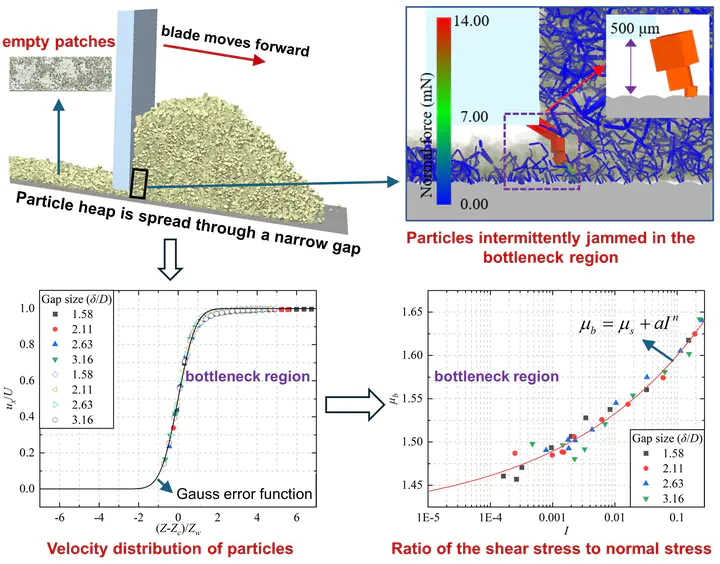
Granular spreading flow is explored through experiments and simulations using the discrete element method (DEM), in which a particle heap on a base is spread through a narrow gap by a moving blade, with the formation of a thin layer on the base. A large rolling friction is used for spherical particles in the DEM simulation, for which a similar flowability as angular particles could be obtained. The results show that different styles of empty patches could be formed on the base, which are related to the spatial structure of intermittent jamming. High localized stress generated during the survival period of jamming could even induce the breakage of particles in brittle material. Interlocking between the particles and the blade or the base is important for mechanical jamming, and the critical gap size for the particle flow without any jamming events increases when the particles with a strong rolling resistance are involved. The shear band mainly exists in the bottleneck region, and its velocity distribution could be well described by the Gauss error function as used in the split-bottom Couette cell. The width of the shear band of angular particles is much restricted by the stationary base when the gap size is small. A separation point exists in the bottleneck region in terms of particle vertical velocity, and its position is related to the blade tip. Because of the combined effects of blade shearing and bottleneck effect, the bulk friction coefficient in this work is larger than that of a traditional shearing flow system.